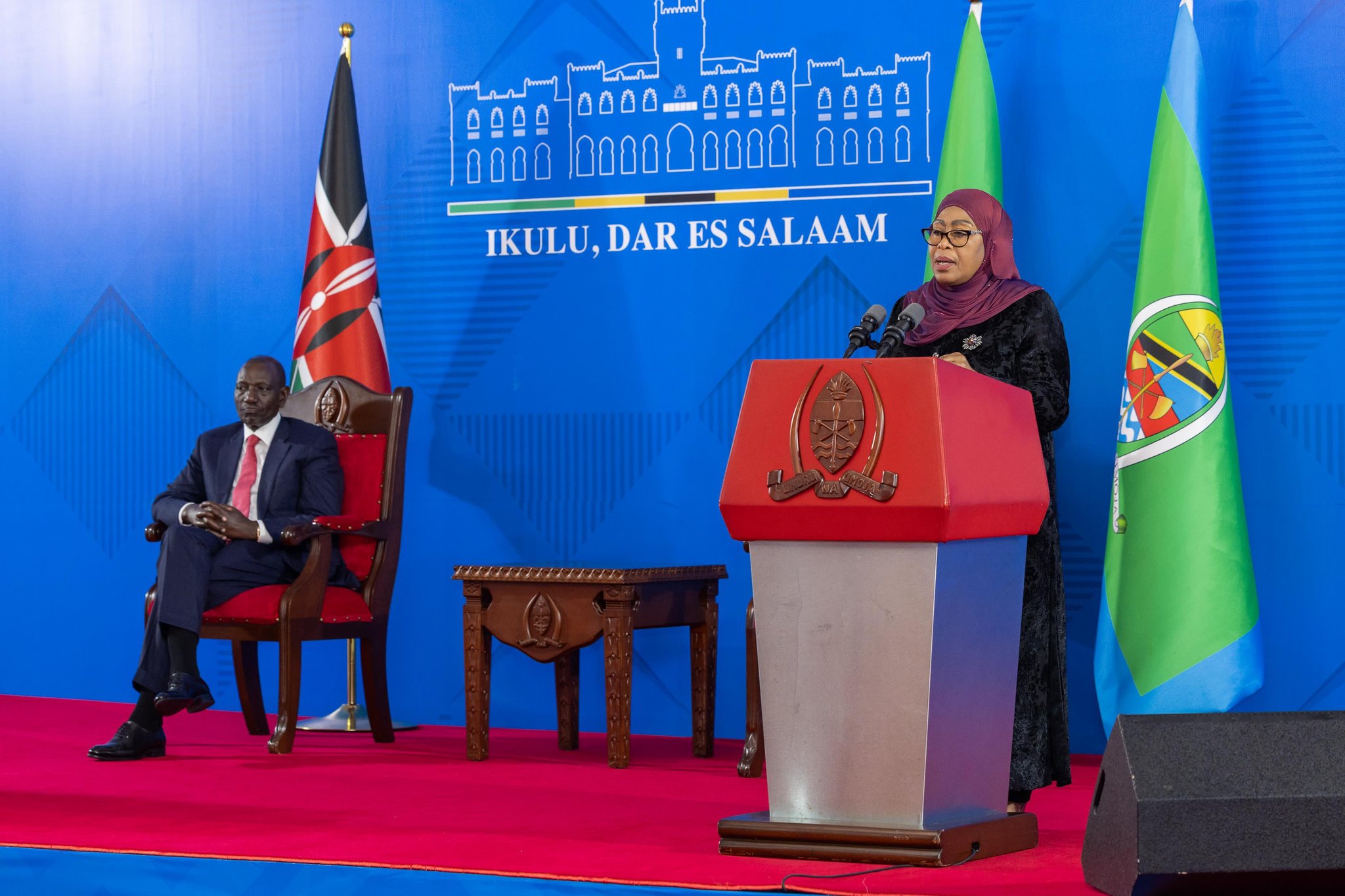
Tanzanian President Samia Suluhu Hassan has publicly called out William Ruto over his earlier announcement of a major oil refinery project in Tanga, exposing a rare moment of diplomatic tension between the two East African leaders.
Speaking during a joint engagement in Dar es Salaam, Samia revealed she directly confronted Ruto over the proposal, questioning why such a significant project on Tanzanian soil had been made public without her government’s knowledge.
“Why did you announce a refinery in Tanga without informing me?” she posed, underscoring concerns over coordination and consultation between the neighbouring states.
The remarks followed Ruto’s earlier statement at a Nairobi summit where he outlined plans for a large, regionally backed refinery in Tanga—an ambitious project expected to process oil from across East Africa, including Kenya, Uganda, South Sudan and the Democratic Republic of Congo.
Samia’s reaction signalled unease within Tanzania’s leadership, with officials viewing the announcement as premature and diplomatically sensitive. Analysts say such declarations, especially involving infrastructure within another sovereign state, typically require prior bilateral consensus.
In response, Ruto sought to ease tensions, clarifying that the refinery plan was not a unilateral Kenyan decision but part of ongoing regional discussions aimed at boosting industrialisation and reducing reliance on imported petroleum products.
He framed the project as a shared economic opportunity for the region, arguing that East Africa must shift from exporting raw materials to processing them locally to create jobs and retain value.
The proposed refinery has also attracted interest from private investors, including Nigerian billionaire Aliko Dangote, who has indicated willingness to replicate his large-scale refinery model in the region if governments align on the plan.
Despite the diplomatic friction, both leaders reaffirmed broader cooperation, signing multiple agreements and committing to deepen trade ties, which stood at over $860 million in 2025.
Still, the brief but pointed exchange has drawn attention across the region, highlighting the delicate balance between regional ambition and national sovereignty in East Africa’s push for large-scale infrastructure projects.