
President Ruto Signs VAT Law, Slashes Fuel Tax to 8% After Public Outcry Over Rising Prices
President William Ruto has formally assented to the Value Added Tax (Amendment) Bill, 2026, reducing VAT on petroleum products from 16 per cent to 8 per cent in a decisive intervention aimed at stabilising fuel prices and easing pressure on households and businesses across the country.

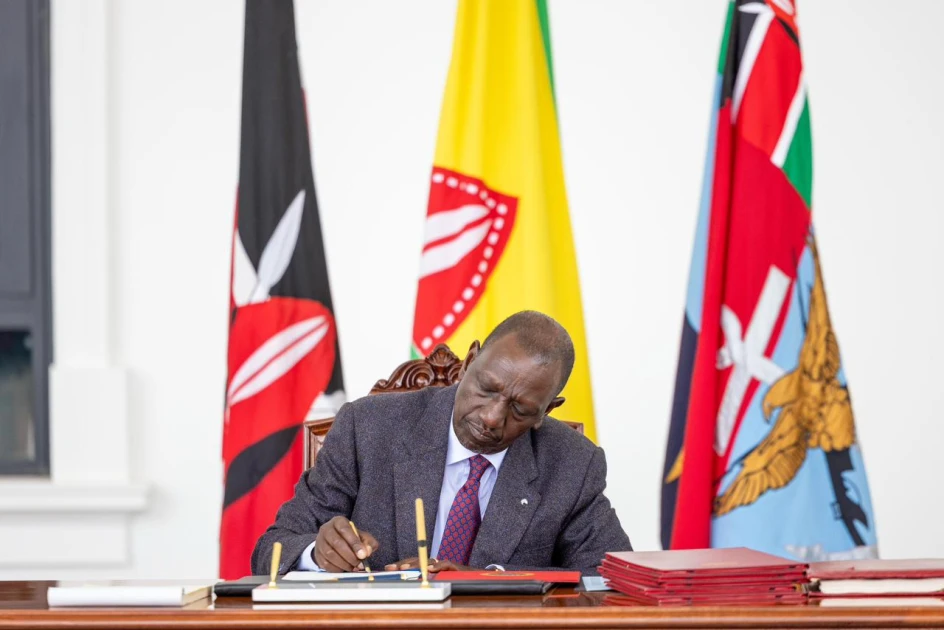
President William Ruto has formally assented to the Value Added Tax (Amendment) Bill, 2026, reducing VAT on petroleum products from 16 per cent to 8 per cent in a decisive intervention aimed at stabilising fuel prices and easing pressure on households and businesses across the country.
The signing, which took place at State House in Nairobi, comes at a time of heightened public concern following a sharp rise in fuel prices that triggered widespread debate over the cost of living and government fiscal policy.
The amendment Bill was sponsored by National Assembly Majority Leader Kimani Ichung’wah and was introduced as an urgent legislative measure following a request from the Executive.
Lawmakers moved with unusual speed, debating and passing the Bill on April 16, 2026, without amendments, underscoring the urgency of the situation and the political pressure surrounding fuel pricing.
According to government explanations, the sudden increase in global oil prices has been linked to ongoing geopolitical tensions in the Middle East, which have disrupted supply chains and pushed up the cost of imported petroleum products.
These global dynamics, officials said, necessitated immediate domestic tax adjustments to cushion consumers from further shocks.
The new law effectively halves VAT on petrol, diesel, and other petroleum products, reducing it from 16 per cent to 8 per cent. The adjustment is expected to have a direct impact on retail fuel prices and, by extension, on transport, food, and production costs across the economy.
Under Kenya’s tax framework, the National Treasury has limited flexibility in adjusting VAT rates beyond certain thresholds. However, the urgency of the situation prompted Parliament to approve a temporary legal override to facilitate the reduction.
The Treasury Cabinet Secretary John Mbadi has been tasked with overseeing the implementation and ensuring compliance with the revised tax structure.
The relief measure is initially set to run for 90 days, with a provision allowing for extension of another 90 days depending on market conditions and government review of global oil trends. The law has also been backdated to April 15, 2026, aligning it with the latest fuel pricing cycle to ensure immediate consumer benefit.
Following the assent, the Energy and Petroleum Regulatory Authority (EPRA), the government agency responsible for regulating fuel prices, announced revised pump prices reflecting the tax cut.
Super petrol prices have decreased by Ksh.9.37 per litre, while diesel has dropped by Ksh.10.21 per litre. Kerosene prices remain unchanged due to separate subsidy considerations.
As a result, the new maximum retail prices now stand at Ksh.197.60 per litre for super petrol, Ksh.196.63 for diesel, and Ksh.152.78 for kerosene.
EPRA noted that fuel costs have a broad ripple effect on the economy, influencing transport fares, agricultural production costs, and the prices of essential goods and services.
The government has defended the move as a necessary short-term stabilisation measure designed to shield Kenyans from global market volatility while broader energy sector reforms are considered.
Officials argue that without intervention, the recent surge in international oil prices would have led to even higher domestic inflation and further strain on household budgets.
However, the decision has also attracted criticism from some economic analysts and members of the public, who argue that repeated cycles of fuel price increases followed by tax cuts reflect a reactive policy approach.
Critics have called for more long-term structural solutions, including increased investment in renewable energy and improved efficiency in fuel importation and distribution systems.
Despite the mixed reactions, the government insists that the VAT reduction is a critical step in stabilising the economy in the short term, with further policy adjustments expected depending on global oil market developments in the coming months.