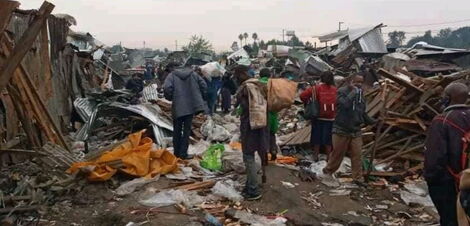
In the early hours of Tuesday 31st march , authorities moved in to demolish a section of the iconic Gikomba shoe market, leaving traders shocked and livelihoods in ruins. The demolition targeted structures along the Nairobi River’s riparian reserve, which officials said were illegal encroachments threatening the riverbank and public safety.
County authorities explained that the demolition followed legal eviction notices issued weeks earlier. “We gave traders ample time to relocate, but some structures remained on the riparian reserve,” said a Nairobi County official who requested anonymity.
The county emphasized that the move was part of a broader strategy to protect the Nairobi River, reduce flooding risks, and improve urban planning.
Despite these assurances, many traders argue that the action lacked adequate consultation and support. Some have called for relocation plans and compensation, warning that the demolition threatens the livelihoods of hundreds of informal workers who rely on Gikomba for their daily income.
Local community leaders have criticized the operation, claiming it disproportionately affects small traders while ignoring larger economic interests in the area.
The demolition also drew political attention. Opposition figures condemned the move, describing it as inhumane and potentially destabilizing for low-income Kenyans who depend on the informal sector.
Social media posts from traders and residents showed images of flattened stalls, scattered goods, and stunned vendors surveying the damage. Many expressed frustration that no alternative arrangements had been provided, leaving them unsure how to continue their trade.
Gikomba Market has long been a hub for Nairobi’s informal economy, particularly known for second-hand clothing and shoes. It provides employment for thousands of traders, porters, and suppliers, and is considered one of the city’s busiest open-air markets.
Authorities argue that protecting the riverbanks is critical, particularly after recent floods and heavy rains affected Nairobi and surrounding areas. The Nairobi River has repeatedly suffered from encroachments and pollution, prompting government interventions in past years.
While the demolition aimed to address environmental and urban planning concerns, the human cost is immediate and palpable. Traders are now forced to seek temporary locations, with many unsure how to recover the capital lost overnight.
Community groups are calling for emergency support programs, including access to credit and relocation assistance, to help those affected rebuild their businesses.
As Nairobi grapples with balancing development, environmental protection, and informal trade, the Gikomba demolition highlights the complex challenges facing city authorities.
For now, the market remains partially cleared, and the echoes of overnight destruction serve as a stark reminder of the tension between urban regulation and livelihoods in Kenya’s bustling capital.
BY EMMANUEL KYENGO